MSO's 100th Anniversary Concert
This is my submission for the “BlogBlog Club - June 2026.” This month’s theme is “Music and Memory,” hosted by Yoz. If you have your own blog, come join in! P.S. I only realized after finishing the draft that it happened to fit June’s theme perfectly, so I figured I’d submit it too!
I just got home from a concert, still riding the excitement and emotion of it, so I’m writing this down while it’s fresh.
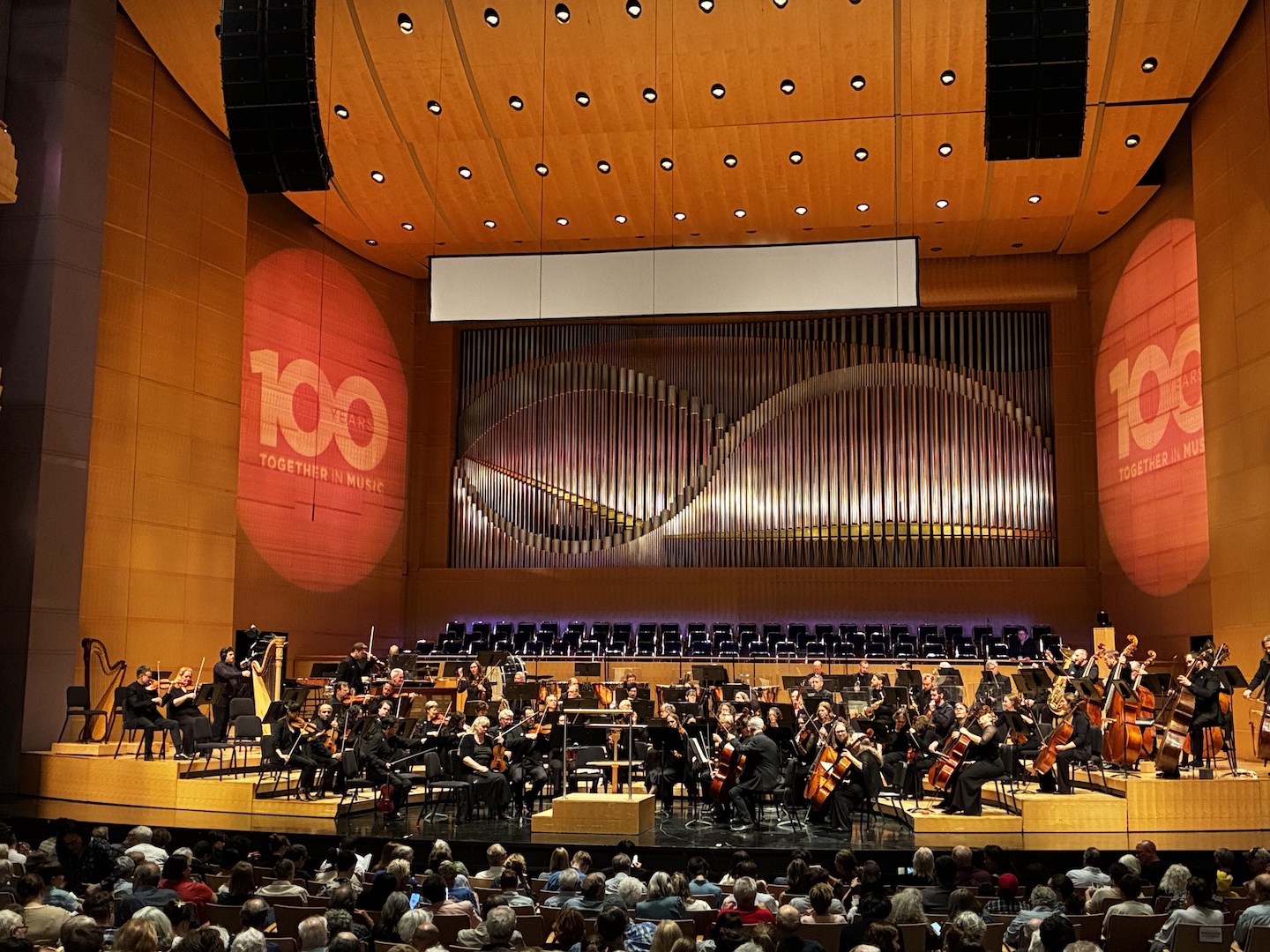
This year marks the 100th anniversary of the founding of the MSO (Madison Symphony Orchestra), and Overture Hall opened its doors to the public for two days straight, with performances of all kinds of music running from morning to night, and all completely free. As local residents, of course we had to go be part of it!
We walked into the concert hall around four in the afternoon and were genuinely stunned by the crowd: it felt like the whole city was trying to squeeze in through that one small entrance (honestly, if this many people showed up on a regular day too, we wouldn’t have to worry about classical music going extinct). We got lucky and found seats dead center toward the back of the main floor, with great sightlines and great acoustics. The concert opened with George Gershwin’s An American in Paris. At first the orchestra seemed like it hadn’t quite woken up yet: this light, charming piece came out a little clumsy and hazy, but as the piece went on, the rhythm grew steadier and the musical expression grew richer.
The most stunning moment of the entire concert was the second piece, Pablo de Sarasate’s Carmen Fantasy for Violin and Orchestra, Op. 25! The solo was performed by Korean-American violinist Julian Rhee, and Rhee’s technique was honestly beyond words: he nailed some brutally difficult wide leaps with pinpoint precision, and his high notes were incredibly delicate. His whole body swayed with the music, and he looked like he was genuinely savoring every second of it. His performance was utterly magnetic. I kept my eyes glued to him the entire time, completely forgetting there was an entire orchestra behind him. Conductor John DeMain mentioned that Rhee, who was born in Milwaukee, won a music competition performing this very piece at age ten, pretty astonishing that someone so young could handle a piece with such demanding technique. His encore, Zigeunerweisen, came just as effortlessly. I have to say, Rhee, with his red-framed glasses, has an absolutely commanding stage presence.
The second half featured Gustav Holst’s The Planets, Suite for Large Orchestra, Op. 32, with four of the seven movements performed: Mars, Venus, Mercury, and Jupiter. Venus stuck with me the most; there’s a section with a main melody layered over repeating chords, building in a way that felt like watching a planet turn steadily on its axis, and I felt like I was floating right in front of Venus, watching it glow with a strange light in the quiet of space.
That sense of stillness got shattered during Jupiter, though to be fair, it wasn’t really the piece’s fault that it felt more chaotic than intended; it was the guy sitting behind me. About three minutes into the piece, a very familiar melody came in: the one used as background music in the Japanese drama Nodame Cantabile. And the guy behind me happily started humming along with the orchestra. If he’d at least been in tune, fine, but he was wildly off-key (facepalm), so I had to scoot forward a little, trying to salvage whatever notes had survived the massacre, scattered across the floor.
The concert closed with Beethoven’s Ninth. Conductor DeMain shared a story: once, after conducting the Ninth, an audience member told him afterward, “I thought it opened with the ‘Ode to Joy’ theme. I didn’t realize we’d have to wait three whole movements for it.”
“So, by popular demand, and also because we’re short on time, we’re only performing the fourth movement today,” he said, with a mischievous grin.
On the afternoon of December 29, 2019, Sam and I once heard the NSO perform the Ninth at the National Concert Hall (yes, I remember the exact date; I have a habit of writing things down). But there were no subtitles that time, so I only had a vague sense that it was a piece praising God. Today, with English subtitles projected in the hall, I finally understood the words more fully, and my heart and my head finally aligned on the same frequency at the same moment, resonating together into a shared sense of awe and reverence for God.
“Brothers, above the starry canopy a loving Father must dwell. Do you fall to your knees, you millions? World, do you sense your Creator?”
The melody built layer upon layer, voices soaring and rising, and as the very last note fell, the balloons that had been tied to the ceiling in all sorts of colors came showering down. The audience erupted in thunderous applause, and so many people kept batting the balloons back and forth, keeping them from touching the ground, as if that alone could stretch out the piece that had just ended, could let them hold on a little longer to a feeling that was already slipping away.
After the concert, the lobby had refreshments waiting: champagne and desserts that weren’t too sweet (the highest compliment a Taiwanese person can pay a dessert). Even with the crowd pressing in, some couples still took little dancing steps together, moving along with another ensemble performing nearby, and the festive energy in the lobby only kept building.
Will classical music disappear one day?
I don’t want to believe it will. Maybe that makes me one of those people batting the balloon too. But for now, in this moment, the balloon is still up in the air, hasn’t touched down yet, and I want to use my words to bat it just a little higher, keep it afloat just a little longer, let it drift all the way into your hands, your eyes, your ears: you, reading this.
NB: This article was first published in Chinese on 06/14/26. It was later translated with assistance from AI tools, edited by me, and published in English on 07/16/26.