
Intro
It has been over two months—nearly three—since this blog launched on October 5th, 2025. Ever since I’ve had this space, I’ve felt an indescribable sense of stability. Ah, it’s like the peace of mind someone feels when they finally buy a house after years of renting.
Originally, I titled this post “The Benefits of Blogging,” but then I thought better of it. “Blogging” is fundamentally “writing,” and the core meaning of “writing” is “creation.” Since I already touched upon that in my post “Why Do We Create?”, I won’t repeat myself here. Instead, I want to focus on the pros and cons of the medium itself: the self-hosted blog.
The Cons
Let’s start with the downside.
The main disadvantage of self-hosting a blog is the incredibly steep learning curve. For someone who studies literature, has never written code and almost never used a terminal, the difficulty level is quite high. It often takes a long time just to grasp the underlying logic of building a website. Personally, I was spared the pain thanks to my husband. Beyond thanking Sam, I’d like to call out to all the programmers out there: your talents give your friends and family a stage to showcase theirs. If you have the time and energy, please don’t hesitate to help those around you set up their own blogs.
The Pros
Now, let’s talk about the advantages.
Wait, you’re asking if that’s it for the cons? Yes, that’s it. And this single disadvantage can be overcome through self-study or the help of friends and family. The control is in your hands.
Absolute Ownership
First and most obviously, the author has absolute ownership. As long as you decide to keep it running, the blog will never be shut down. Back in elementary school, “Wretch” (無名小站) was huge. I remember almost all my classmates had accounts; we’d visit each other’s pages and obsess over the “Who’s visited me” list. Beyond that, we never tired of picking out beautiful themes for our blogs (I think I chose an autumn maple theme). As a kid, I wrote several posts there—mostly “teen angst” essays. Some were locked, meant only for my best friends. Of course, many classmates also used locked posts to talk behind people’s backs.
However, the once-glorious Wretch shut down in 2013. By then, I had been using Facebook for four years and had moved my focus there, so I didn’t feel much when Wretch closed. I thought Facebook was good enough. I was so young back then; now, I have no way of knowing what “Little Alice” wrote in her blog.1
In contrast, a self-hosted blog won’t vanish because of someone else’s business decisions. If you want it open, it stays open. If you decide one day you’re done, you take it down yourself.
A Great Way to Share Travelogues
Secondly, something I realized while writing my Journey to the West series: if you want to share travel photos with family and friends, sending a direct blog link is the most space-efficient and meaningful method. Your recipients don’t have to clear out their messaging app storage because of your heavy photo files. Furthermore, unlike writing detailed travel notes directly in a chat app—which risks “information overload” for the recipient—it’s perfectly normal to write long-form text around images on a blog. You can provide interesting captions and reflect deeply on the experience. You might say, “Can’t I do this on FaceBook or Instagram?” Well, your friends and family might not use those platforms! (I am that friend who doesn’t use Instagram).
High Autonomy in Layout
Thirdly, a point many people mention: the autonomy over layout. Self-hosted blogs are vastly superior to other platforms in this regard.
The biggest drawback of using social media or pre-built blog services is that you cannot change the existing layout settings. Worse, when the platform updates, you are forced to accept the new look, whether it’s pretty or ugly.
A long, long time ago, I started a Medium account and wrote two articles. Then I got busy and stopped. One day, on a whim, I thought about going back to write something. I clicked in and found: What! Why were the titles changed to this hideously ugly italics? And I couldn’t even change it back. My eyes hurt. Medium was bossier than my landlord. My landlord can’t just barge into the room I rent; but when I write on Medium, they have the right to barge in and paint my walls bright purple without me being able to say no.
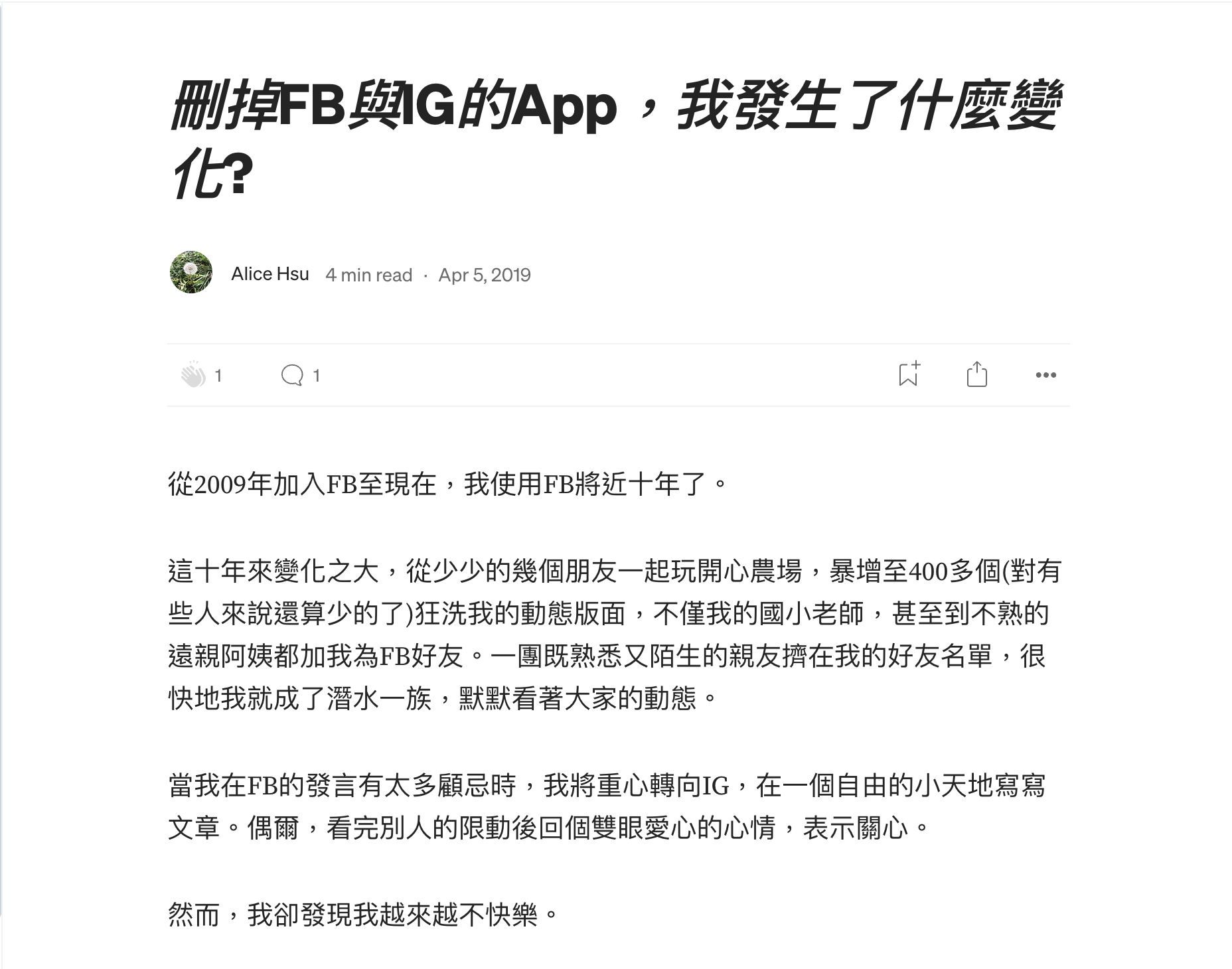

(The difference is clear, right?)
With a self-hosted blog, you are no longer subject to others’ whims, and you can start doing “out of the box” things. For example, you can draw your own Christmas illustrations and place them in the corners of your blog; you can decide on every element, like drawing your own Favicon (the colorful smiling note for this blog is my own drawing!). You also get to decide if a post needs images and how they should be presented. Unlike Instagram, where photos are mandatory and must come before the text, or Facebook, where text always precedes photos, neither allows for a truly integrated “interwoven” layout.
Your creativity is precious and unique. Don’t imprison it in Facebook’s #1877F2 blue and white prison uniform!
Additionally, authors can categorize posts systematically, making it easier for readers to understand their perspective on a specific topic. For instance, you can see my posts organized by subject in the “Categories” section, or click on orange text within an article to jump to a related post. These are features current social media lacks.
No Need for “Likes,” “Hearts,” or “Claps”
Finally, and perhaps most importantly: on your own blog, you can choose not to have “Like,” “Heart,” or “Clap” buttons.
Fun Fact
Did you know? Facebook didn’t actually have a “Like” button at the start. That button was added on February 9, 2009, five years after the platform was founded—a decision that made Facebook a fortune. Then in 2016, they added six more moods.”2
These mechanisms allow readers to express non-verbal reactions quickly, and authors to receive instant feedback. However, “fast” and “efficient” aren’t necessarily “good” for human well-being. In my view, while articles spread much faster and are easily seen, this convenience fosters a specific habit: as a reader, it’s easy to just give an emotional reaction rather than truly digesting and understanding what the author is saying. As an author, it’s easy to measure the value of your work by quantified likes, or even use like counts as a standard for creation. Think about it: many masters of painting, music, and literature were ignored during their lifetimes, only to be discovered and celebrated by later generations. If social media existed back then and they judged their work by “likes,” we might not see many Van Gogh paintings in museums today.
To be honest, when I used to post on social media, my mood would fluctuate based on who liked my posts and who didn’t (be honest, you do it too, don’t you?). These fluctuations would affect my state of mind for the next post. I found my writing becoming more and more constrained, my motivation swaying in the wind.
Since I started writing on my own blog three months ago, writing has become something much purer: If no one “likes” or “claps,” why am I still writing? It seems I can write more for the sake of sharing things I love, things I find interesting, valuable, and meaningful.
I won’t claim to be entirely selfless; I must admit that sometimes I really want my work to be seen (which is why this blog has a “Portfolio” page). However, writing on my own blog, without those heart and like mechanisms, makes the act of writing and composing feel much steadier. I can enjoy the satisfaction of the work itself, rather than feeling elated or dejected based on someone else’s emotional feedback.
But please don’t misunderstand—I still very much look forward to interacting with readers. I’m always happy to receive emails. To me, constructive written feedback is far more meaningful than a quantified number of likes or hearts.
The Happy Farmer
That’s about all for the pros and cons of self-hosted blogs. I’m not sure what this blog will look like in the future. Just like three months ago, I couldn’t have imagined it would be this colorful! I’ll just keep writing and drawing. I am no longer an internet peasant; I am a farmer with my own acre of land, continuing to cultivate here happily.
Afterword
After finishing this, it feels more and more like a recommendation post. If you are interested in self-hosting a blog, feel free to check out BlogBlog Club for resources!
NB: This article was first published in Chinese on 12/28/25. It was later translated with assistance from AI tools, edited by me, and published in English on 01/08/26.
Actually, you can try searching via the Internet Archive’s Wayback Machine, but I’ve even forgotten my account name. If you remember yours, you can follow this tutorial: https://www.elle.com/tw/life/tech/g64365475/find-wretch-back/ ↩︎
This history comes from this report: https://apnews.com/article/like-button-facebook-history-book-89d00e73c7c6da500b06e251d44b858c ↩︎