

How it began
Writing piano covers has been a way for me to train my arranging skills. In other words, it feels a bit like translation. You take a song performed by a full band and rewrite it so it makes musical sense on the piano, which gives me a sense of accomplishment.
I chose Fujii Kaze’s Kirari because I wanted to challenge myself with a style that is not usually in my comfort zone. There are plenty of piano versions of this song on YouTube, yet after listening to several, I realized many of them felt either too busy or a little dull. So I set a goal for myself, namely to create a version that would stay enjoyable throughout, with accompaniment patterns that keep shifting from one section to the next.
In the end, I realized the arranging was the easy part. The real challenge was the practicing.
ヽ(;▽;)ノ
A while ago, I injured my hand during practice. To be specific, the injury came from switching from piano to an older keyboard and accidentally using the wrong muscles, which eventually caused strain and pain. Because of that, practicing this quite demanding piece became a slow and interrupted process. Still, I finally managed to finish recording it recently. (Big thanks to physical therapists 啾 C and SunGuts for all the hand-stretching videos.) There are still a few imperfect spots, but overall I feel satisfied with how it turned out.
How I arrange a piano cover
Here is the general workflow I follow:
- Identify the vocal melody quickly and map it to the right hand.
- Slow the track down to 0.5x to fix any rhythmic parts I misheard.
- Write out all the chords.
- Turn those chords into accompaniment patterns for the left hand.
- Practice the draft version and revise anything that feels unnatural for me, and repeat that cycle as needed.
One major advantage of writing my own covers is the freedom to revise anything at will. That is to say, if something feels awkward or inefficient for the hands, I can remove it immediately. As someone who grew up playing classical music, being able to rewrite the score feels a little like bending the rules lol.
Tool One
I used a few tools during the arranging process. The first one was an online music separation tool that splits vocals from the instrumental track. This helped a lot in the second, third, and fourth stages of the process. When listening only to the vocals, I can focus entirely on pitch and rhythm without the band getting in the way. When listening only to the instrumentals, I can analyze the harmony and the band arrangement much more clearly. (Of course, this is only a rough guideline, since identifying the chords still requires taking the vocals into account.)
Tool Two
The second tool was Wiwi’s pitch detector. When the rhythm becomes fast and I cannot quite tell which note Fujii is singing, this tool becomes extremely helpful. I slow the song to 0.5x, turn on the pitch detector, and check the exact note. Since the vocals are usually the loudest in the mix, the tool works well for this purpose.
The most enjoyable stage
Stage four is where creativity can shine, and for me, it is the most enjoyable part of the entire process. Once the main melody and chords have been faithfully “translated,” what remains is the part that is “untranslatable.” That is to say, it’s a blend of timbres that only a full band can create, and that a piano simply cannot reproduce it in the same way. This is the exact stage where I can write freely and follow whatever musical idea feels right.
Section One
One passage I feel proud of begins at measure 66:

The original arrangement here is actually quite complex. I eventually decided not to recreate the intricate harmonies and instead expressed the complexity through the rhythm. It is not easy to play. I later found that keeping my wrist loose increases accuracy.
Section Two
Another section I really enjoy begins at measure 33, which is the start of the chorus.
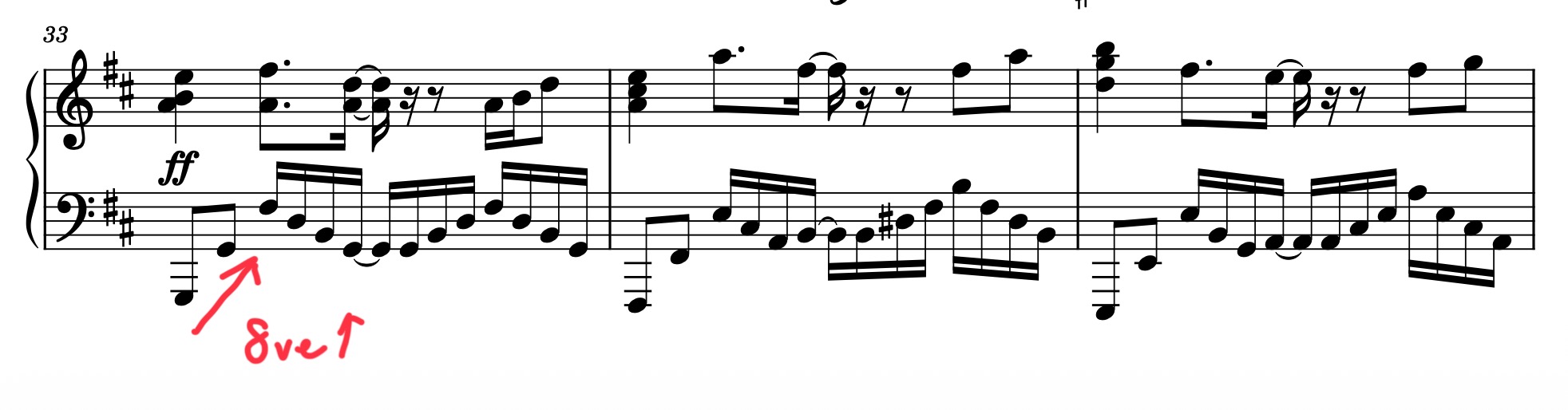
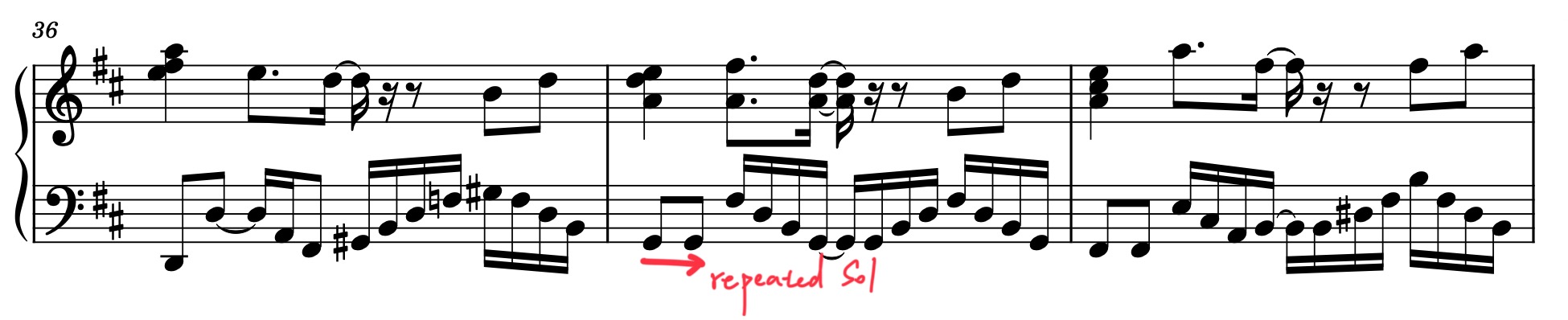

Since the chorus is fairly long, I wanted the accompaniment to stay engaging. For example, the first beat originally moves upward in octaves, yet after four measures I switch it to repeated notes instead. Another change is that the second beat originally used sixteenth notes, while later I changed it to dotted eighth notes. I like how these subtle variations keep the music alive.
Final thoughts
There are spots where my recorded performance is not identical to what I wrote, although perhaps this is the privilege of being both the arranger and the performer, which means I can change whatever I want. Next time, I plan to challenge myself with a project in a completely different format. I hope you will look forward to it :)
Here is the full version:
NB: This article was first published in Chinese. It was later translated with assistance from ChatGPT, edited by me, and published in English.