
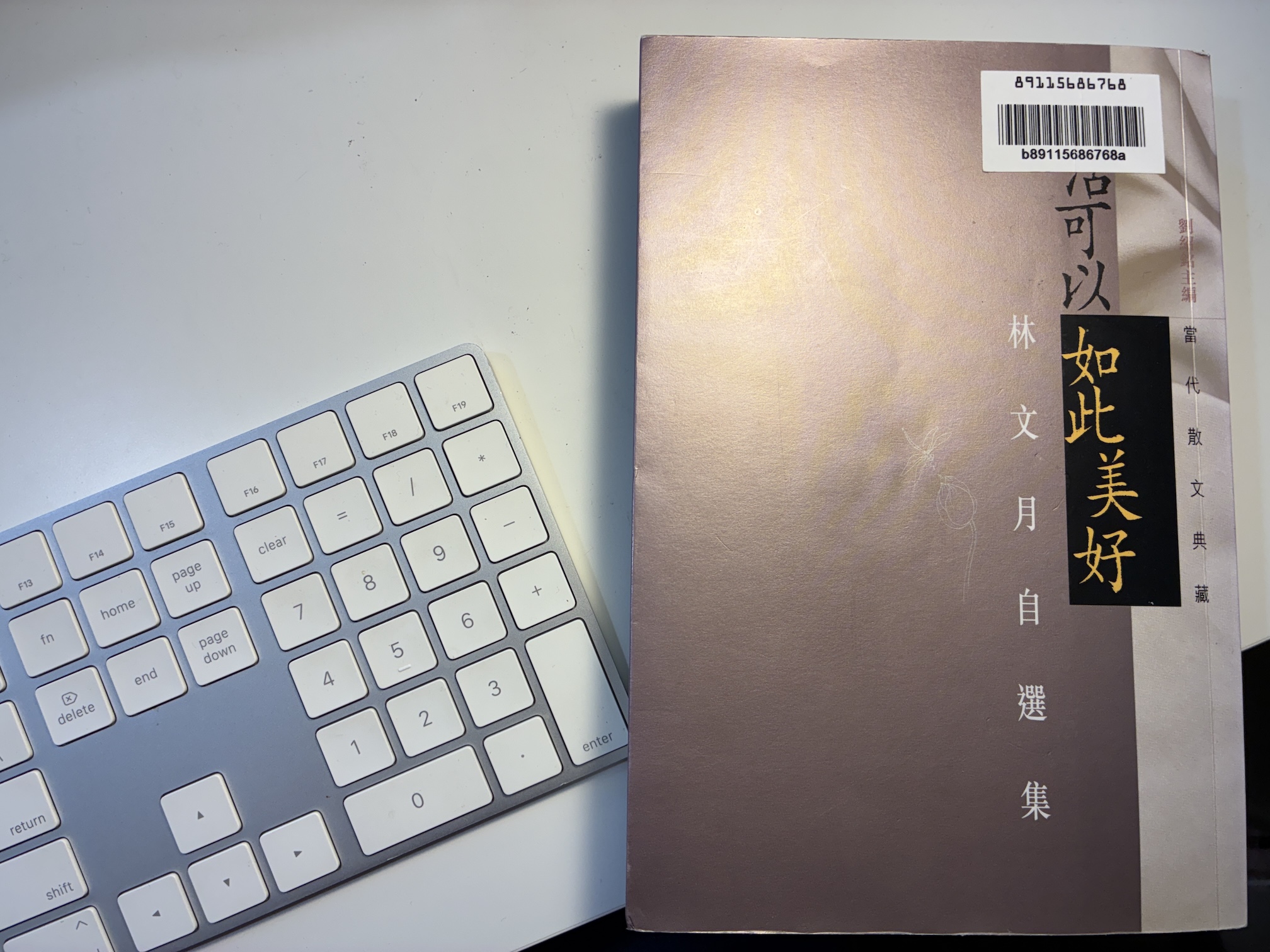
Recently, I’ve been reading Life Can Be So Beautiful,1 a collection of essays written by Professor Lin, Wen-yueh (1933–2023). In one article, “A Letter to My Daughter—In the Style of Fu Lei’s Family Letters” (written in October 1987), she discusses several sources of inspiration for artistic creation. Her words are deeply thought-provoking, and I feel compelled to respond to them. Here is the original passage:
Where do creativity and innovation come from?
Of course, the education you receive at school provides a crucial foundation.
But no matter what kind of art you pursue, you must possess a wealth of knowledge, noble character, and a passionate heart.
These qualities require daily effort in your reading habits and attitude toward life.
I have often felt that professional knowledge alone is insufficient for a creator. Take painters, for example,
even if they thoroughly understand the history and principles of art, and possess complete mastery of techniques, they may become skilled painters who know how to color and arrange objects in their painting.
But what contents will they express?
That depends on their inner cultivation and depth of thought.
Once we reach that level, it’s no longer merely a question of professional knowledge.
Ultimately, one must read widely across various fields, think deeply, and show more concern to the world.
Only then can you enrich your knowledge and your life—and thus have an inexhaustible source of ideas to express. (p. 122)
According to Lin, the sources of creation can be summarized in three key elements:
- A wealth of knowledge
- Noble character
- A passionate heart
Here is my interpretation of each:
A wealth of knowledge: This includes theoretical and historical understanding related to art, the ability to appreciate it, and the technical skills necessary for artistic creation.
Noble character: I believe this involves two aspects. First, caring about others, that is to say, not assuming the world revolves around oneself, but being willing to invest energy in understanding people—whether those close to us, like family and friends, or the larger society. Second, good taste: a person of refined taste can discern what truly adds value to life and what does not.
A passionate heart: What’s fascinating is that Lin adds the word “passionate” before “heart.” I imagine this implies that ordinary love is not enough. To simply love music or love painting is not sufficient to become an artist. It may only make one an appreciator or an artisan. A person who loves art passionately, however, makes art an inseparable part of life; they constantly strive to surpass themselves, to move forward, to keep creating.
Lin mentions that reading is a way to cultivate these sources of creativity. Yet, I feel reading emphasizes the intellectual dimension, which, while important, lacks the sensory aspect of exploration.2 To me, it’s also essential to engage the senses in daily life:
To gaze intently at the scenery around us;
To listen attentively to the chirping of insects and birds;
To savor the aroma of freshly cooked food;
To feel deeply the beauty of the world and to share that beauty through creation.
Of course, there’s another aspect too: the courage to face suffering, allowing one’s art to ease the pain of others; to hear the cries of those afflicted by injustice, and to let one’s work help restore fairness and empathy in the world.
Although I never had the chance to meet Professor Lin, I feel a sense of longing as I read her words. If it were possible, I would love to take her course on Literature during the Six Dynasties. And even more, to have a cup of coffee with her, to talk about literature, and to exchange thoughts on creation.
NB: This article was first published in Chinese. It was later translated with assistance from ChatGPT, edited by me, and published in English.
The book title and the following quote are translated by me. It is originally written in Chinese and hasn’t been translated into English yet. ↩︎
Perhaps Lin simply didn’t think it necessary to mention this. She probably couldn’t have imagined how, decades later, people’s attention would plummet under the influence of smartphones. ↩︎